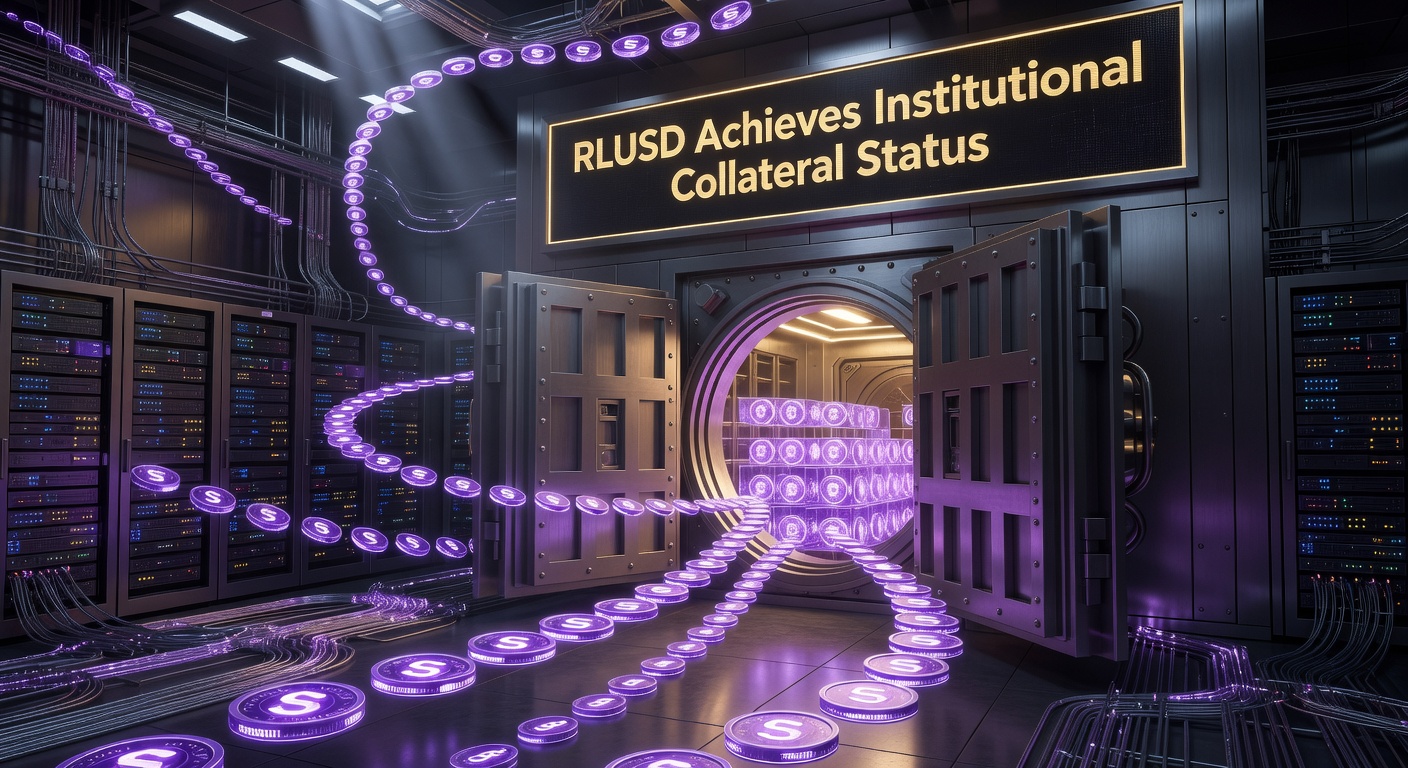
RLUSD Crosses Into Institutional Collateral Territory
OKX's RLUSD listing and Bullish's BTC options integration didn't just expand the stablecoin's reach — they moved it into a different tier entirely. Here's what institutional collateral status actually means.
Two moves in one week redefined RLUSD's position in the stablecoin market. On April 29, 2026, OKX listed RLUSD — adding one of the world's largest exchanges by volume to the stablecoin's distribution footprint. Then, on May 3, Bullish became the first US-regulated exchange to accept RLUSD as collateral for BTC options trading. Simultaneously, Ripple Prime plugged into Bullish's BTC options market, connecting institutional clients directly to XRPL-native settlement infrastructure.
Taken individually, each move is notable. Taken together, they represent a category shift. RLUSD didn't just get more listings — it crossed into the tier of stablecoins that institutional trading desks will post as margin for derivatives exposure. That's a different market, different counterparty relationships, and a different level of trust signal than a spot trading listing.
The Two Tiers
The stablecoin market has a structural divide that most coverage elides. It's not about market cap or daily volume, though those matter. The divide is between stablecoins that institutional trading infrastructure will accept as collateral and those it won't.
Tier 1 — collateral-grade: USDT and USDC have spent years becoming the margin and collateral currency of choice for institutional trading desks, prime brokers, and derivatives venues. When a hedge fund opens a leveraged BTC position on a regulated exchange, the collateral posted is almost invariably USDT or USDC. This status wasn't granted — it was earned through regulatory engagement, balance sheet transparency, and repeated integration with institutional infrastructure.
Tier 2 — everything else: Most stablecoins, regardless of their technical merits or market cap, sit outside collateral acceptance. They may be listed for spot trading. They may have DeFi liquidity. But regulated derivatives venues — the institutions that manage counterparty risk professionally — haven't accepted them as collateral. The compliance review process for collateral acceptance is distinct from and more rigorous than the review for spot listing.
RLUSD has now crossed from Tier 2 into Tier 1 acceptance. Bullish's decision to accept it as BTC options collateral isn't a marketing event — it's the result of a compliance process that evaluated RLUSD's regulatory standing, custodial structure, redemption mechanics, and counterparty risk profile.
What Makes RLUSD Different
RLUSD's path to collateral-grade acceptance rests on a specific set of structural characteristics that differentiate it from most of the stablecoin field.
NYDFS regulation. RLUSD is issued under New York banking law, with oversight from the New York Department of Financial Services. The NYDFS imposes requirements on reserve composition, redemption mechanics, and audit frequency that go beyond what most stablecoin issuers face. This is not a favorable regulatory classification obtained after the fact — RLUSD was designed and launched within this framework.
1:1 USD backing with monthly attestations. Every RLUSD in circulation is backed by US dollars held in reserve. Monthly third-party attestations verify the reserve composition. This is the structure that institutional compliance teams require before accepting a stablecoin as counterparty-eligible collateral — they need to know that redemption risk is bounded and verifiable.
Not algorithmic. In the post-Terra environment, the distinction between fiat-backed and algorithmic stablecoins carries serious institutional weight. RLUSD's reserve structure eliminates the class of risk that made algorithmic stablecoins unacceptable as institutional collateral. This seems obvious, but it materially narrows the field of stablecoins that can pass institutional counterparty review.
XRPL-native settlement. RLUSD settles natively on the XRP Ledger, with all the finality and speed characteristics that entails. For institutions whose settlement infrastructure is increasingly integrating XRPL payment rails, having their primary margin currency native to that ledger reduces settlement complexity and counterparty hop count.
ISO 20022 alignment. XRPL's ISO 20022 compatibility means RLUSD transactions can carry rich, structured payment data compatible with the global correspondent banking messaging standard. For institutional operations that require transaction metadata for compliance and reconciliation, this matters.
Why Collateral Acceptance Matters
A spot listing gets you exposure to retail and algorithmic trading volume. Collateral acceptance gets you embedded in institutional balance sheet management. These are categorically different positions in the financial ecosystem.
When a regulated US exchange like Bullish accepts a stablecoin as collateral for derivatives, the process behind that decision includes: legal review of the issuer's regulatory standing, compliance review of the reserve and redemption structure, risk management review of the stablecoin's historical stability and redemption events, counterparty risk assessment, and board or committee sign-off on the new collateral type. That process is not fast and it is not casual. It represents institutional validation that the stablecoin meets the standards required for it to sit on a regulated firm's balance sheet as a liability offset.
The consequence of passing that review is compounding. Once a stablecoin is accepted as collateral at one regulated venue, the compliance documentation generated during that process becomes the basis for the next venue's review. Institutional standards propagate through the network. RLUSD's Bullish acceptance is not just one integration — it's the first entry in a collateral acceptance record that makes subsequent integrations faster.
What It Signals for XRPL Payment Rails
The Ripple Prime connection to Bullish's BTC options market is the piece of this story that matters most for XRPL infrastructure builders. Ripple Prime is the institutional liquidity and payment service offering that connects corporate and institutional clients to Ripple's XRP-based payment infrastructure. Its integration with Bullish means institutional clients executing BTC options trades are settling through XRPL-connected infrastructure.
When institutional desks hold RLUSD as collateral for derivatives positions on a regulated exchange, and that exchange settles through XRPL-connected infrastructure, the practical result is institutional liquidity sitting on the ledger. Liquidity attracts more liquidity. Institutions whose treasury teams hold RLUSD as a margin currency will begin considering XRPL as a settlement layer for other operations — cross-border payments, RWA issuance, interbank transfers.
The OKX listing compounds this. OKX serves a client base that spans retail traders, crypto-native hedge funds, and increasingly traditional financial institutions with digital asset exposure. RLUSD on OKX reaches the institutional desk segment of that client base — the portion with compliance requirements that make collateral-grade stablecoin standing a prerequisite for use.
For DLT infrastructure builders using XRPL as a settlement layer, RLUSD's entry into institutional collateral territory changes the calculus on product design. XRPL-native settlement tooling that incorporates RLUSD as a settlement currency can now credibly target institutional trading desks — not just as a future-state promise, but as a current capability. The stablecoin's collateral acceptance is the proof point that the institutional infrastructure conversation is live.
The infrastructure layer of XRPL-native finance is being assembled one integration at a time. RLUSD's collateral acceptance at Bullish, the OKX listing, and Ripple Prime's institutional connectivity represent the payment and settlement foundation. The application layer — compliance tooling, portfolio infrastructure, reporting systems — is where the buildout opportunity sits for the next generation of XRPL-native products.
Explore the Ecosystem
StackStats Apps builds DLT infrastructure for the market institutional platforms don't serve. XRPL-native, compliant, accessible.
Visit StackStats Apps →